
What Your Major is Worth in California
August 28, 2026
For a long time, a college degree came with a guarantee, spoken or not: enroll, graduate, and a job and financially secure future would follow. That assumption is no longer taken on faith. Costs have climbed, student debt has become the norm, and the economic return of attending college is in question. Even as the economy demands some sort of college for nearly three-fourths of jobs by 2031, confidence in higher education's ability to deliver on its promise is steadily slipping.
That shift matters most in a state the size of California. With close to 40 million residents and one of the largest, most varied higher education systems in the country — community colleges, the CSU and UC systems, private and for-profit institutions alike — Californians collectively spend billions of dollars and millions of hours earning degrees and certificates every year. They deserve a clear, verifiable answer about what that investment actually returns, field by field and credential by credential.
That's what this report sets out to provide. Drawing on the most recent earnings data released by the federal government, this analysis examines how economic outcomes vary by field of study and credential level for graduates of California colleges and universities. It is California-specific, covering 386 institutions, 2,958 individual programs, 276,963 graduates, and 225 distinct fields of study throughout the state.
The outcomes in this report aren't meant to rank one major against another. A degree in social work and a degree in computer science exist for different reasons, and both carry societal value beyond pure economics. Nor is the report suggesting that outcomes are uniform across institutions. A bachelor's degree in psychology at one school will yield different results than at another. And while some majors are linked to higher earnings, there may be other factors beyond the major itself that are also associated with higher incomes.
Instead, this report is meant to give prospective students, families, and counselors clear information on the earnings tied to specific fields of study, so that choosing a college and a major can be more informed than in years past. It also gives college leaders a birds-eye view of state-level outcomes to inform a more nuanced review of their programs, where results vary by credential, skills, and regional job availability.
In This Report
01Earnings by credential level
On average, more education is associated with higher career earnings. This chart shows the typical earnings for certificate, associate, and bachelor’s programs in California four years post-graduation. As a comparison, the typical salary for a high school graduate in California with no college experience ($36,082) is also provided, to assess the earnings premium that each type of credential generally provides.
Search your major
Search for a field of study to view the earnings of graduates four years after they’ve completed their credential from an institution in California.
Start typing or choose a major from the dropdown.
Highest-paying majors
Following national trends, the highest salaries for college graduates in California are generally more concentrated in science, technology, engineering, and mathematics. This chart highlights the highest-earning majors for bachelor’s degrees, associate degrees, and certificate programs.
Popularity does not always match pay
Students don't choose majors on salary alone, and college leaders don't solely shape program offerings based on graduate earnings alone. Below are the five most popular majors for each credential type in California, with corresponding salaries four years post-graduation. Completers only reflect financial aid recipients included within federal earnings data, meaning the overall number of graduates will likely be more for each field of study.
Which degree bump pays off most?
Obtaining a higher degree within a specific field of study often provides a substantial increase in earning potential. However, this varies by the field of study and type of credential that students obtain.
Methodology
The data in this report originate from the U.S. Department of Education (ED), which provides the median earnings outcomes for graduates four years after completing their program of study. Program outcomes reflect students who completed their credential between 2017 and 2019, with earnings measured in the 2022 and 2023 calendar years. Earnings figures are then adjusted for inflation to reflect 2024 dollars. These earnings data come from a partnership between ED and the U.S. Department of the Treasury. If a program's graduates received federal student aid at an approved institution, their IRS-reported income is generally included. Graduates of other institution types, or those who never applied for aid, are not.
Students included in these data must have: 1) earned their credential from a college program centrally located in California; 2) received federal student aid; 3) been employed at the time of measurement; and 4) not been enrolled in school during the measurement year. Students who do not meet these criteria are excluded from the analysis. In total, this analysis includes 1,779 bachelor's programs, 635 associate's programs, and 544 certificate programs across California. Programs are classified through institutional reporting and are presented at the federal 4-digit Classification of Instructional Programs (CIP) methodology, which defines a specific field of study.
Aggregation and weighting
This report combines similar programs offered by different institutions to determine typical graduate earnings by field of study and credential type. To produce a single, representative earnings figure for each field-and-credential combination (e.g., "Bachelor's Degree in Business Administration"), earnings are combined into a completer-weighted average, so programs with larger graduating classes carry more weight than smaller programs. Individual program outcomes, which are used to inform the completer-weighted average, will vary from institution to institution.
To avoid drawing conclusions from very small programs, this analysis applies a minimum statewide threshold of 100 completers for the Highest-paying majors and, for the "Which degree bump pays off most" section, a threshold of at least 5 college programs statewide at each credential level being compared (e.g., at least 5 certificate programs and at least 5 associate's programs) and 500 aggregate completers across both levels. The "Search your major" section applies a smaller threshold of 50 to provide more nuance to users interested in a specific credential. Fields below this threshold are excluded from the charts and tables highlighting specific fields of study, though they remain part of the underlying California dataset. The weighted average earnings for every credential and field of study, regardless of completer count, are provided in the Appendix.
Earnings benchmark
The "typical high school graduate" benchmark used throughout this report is $36,082, California's median earnings for high school graduates who are aged between 25-34 years old. These data are calculated by ED, using data captured through the United States Census Bureau. This benchmark helps indicate how much of an earnings premium a given field of study produces relative to California residents with a high school diploma and no college experience.
Appendix: All majors and earnings
This appendix lists the level of credential, major, number of completers within the data, and salaries used within this report. Majors are listed alphabetically.
| Major | Credential Level | Earnings | Completers | Programs |
|---|
This report was made possible with the support of the ECMC Foundation, a national foundation whose North Star goal is to eliminate gaps in postsecondary completion by 2040.
As the cost of college rises and confidence in its economic value declines, students and families increasingly need clear information about what different degrees and credentials deliver. This report analyzes federal earnings data for 276,963 graduates across 2,958 programs, 225 fields of study, and 386 California institutions to show how outcomes vary by field and credential level.
Public Agenda and The HEA Group announced a two-year collaborative initiative to improve data transparency and economic mobility across California’s higher education landscape.
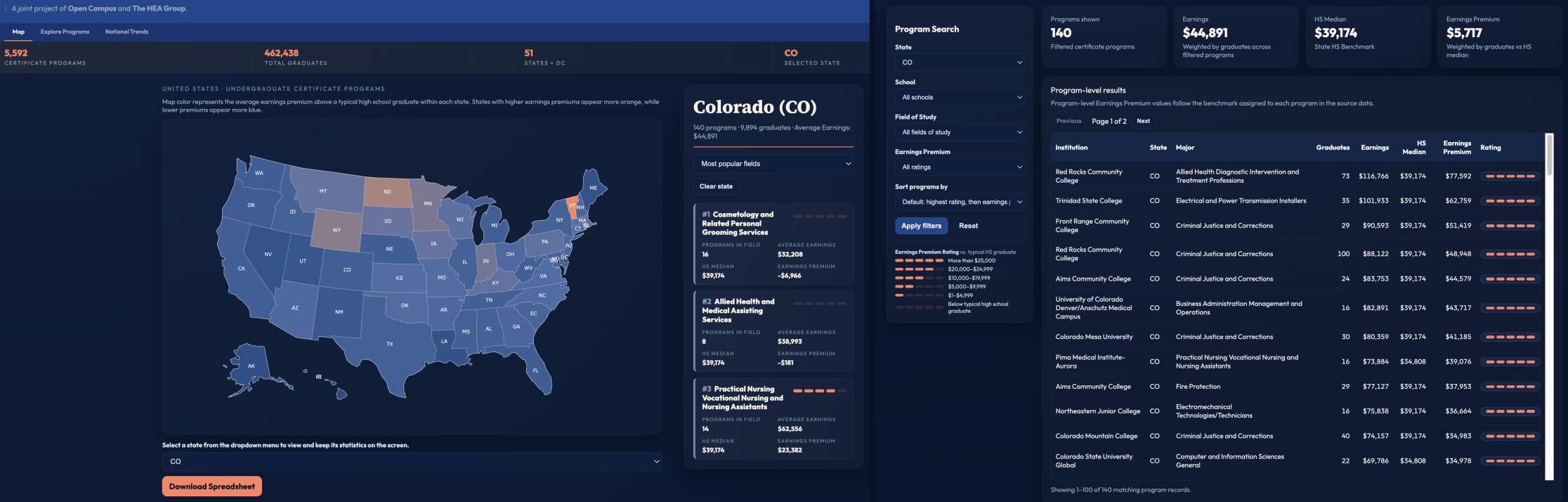
Are certificates worth it? For which programs? Do they align with Colorado's future economy? With a new short-term Pell Grant program launching on July 1, 2026, The HEA Group President Michael Itzkowitz argues that Colorado policymakers have a real opportunity to boost the state’s economic prosperity if they can answer those questions.