

Understanding the Value of Short-Term Credentials in Colorado
Written by Michael Itzkowitz, Founder and President of The HEA Group.
As featured in The Rise Report Newsletter on June 25th, 2026.
Are certificates worth it? For which programs? Do they align with Colorado's future economy? With a new short-term Pell Grant program launching on July 1, 2026, Colorado policymakers have a real opportunity to boost the state’s economic prosperity if they can answer those questions.
Fortunately, The HEA Group and Open Campus just released the inaugural Certificate Earnings Explorer (CEE), an interactive resource that allows users to explore earnings outcomes for over 5,500 undergraduate certificate programs and more than 462,000 graduates nationwide. One hundred and forty of these programs fall in Colorado.
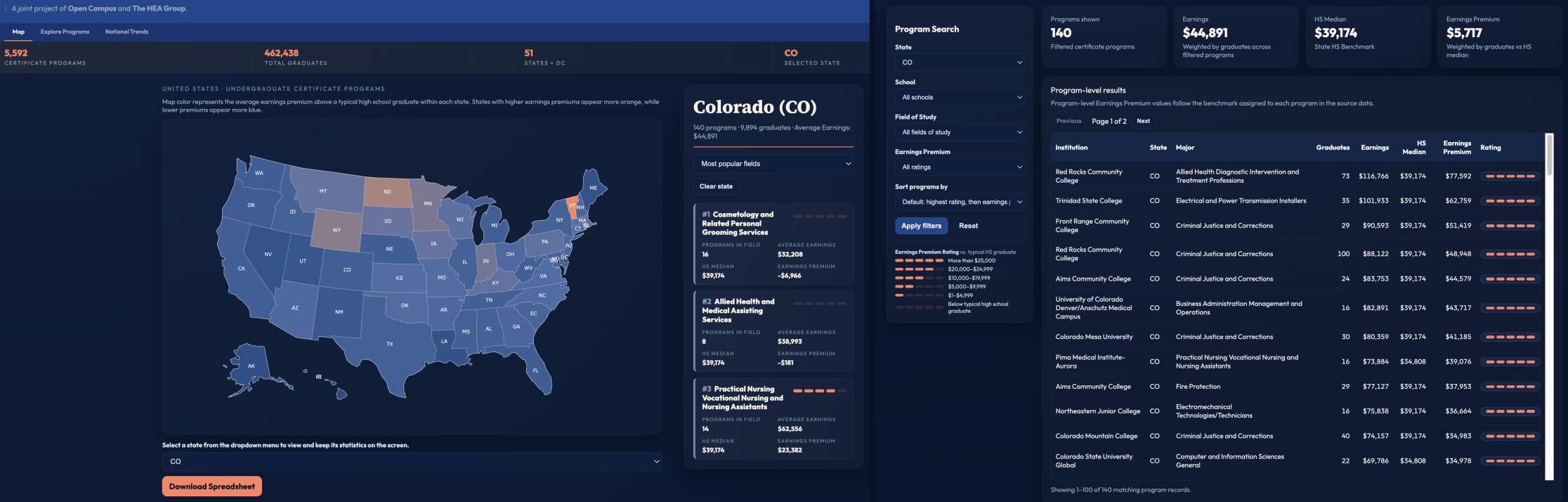
The Colorado dashboard from the Certificate Earnings Explorer.
These earnings data on former students come from the U.S. Department of Education. If a program's graduates received federal student aid at an approved institution, their IRS-reported income is likely included. If they attended a different kind of institution, or never applied for aid, it isn't.
This is a critical starting point. As short-term Pell dollars become available to newly approved programs, lawmakers have an obligation to target that money effectively and efficiently, toward those that are aligned with Colorado's future job market and that show strong outcomes for students. The CEE's data on "longer-term" certificates, those with at least 16 weeks of instruction, offers useful insight before approving newer, shorter ones.
A couple of key trends stand out.
First, some of the most popular certificate programs in Colorado produce the least favorable outcomes. The two most popular, Cosmetology and Allied Health and Medical Assisting, show the majority of certificate holders earning less than the typical high school graduate with no college experience. The most popular Allied Health and Medical Assisting program in the state, offered at Concorde Career College in Aurora, shows the lowest earnings for that credential anywhere in Colorado.
Second, the same credential can produce radically different outcomes depending on which institution offers it, the skills it equips students with, and where it's located. Graduates with a certificate in Vehicle Maintenance from Trinidad State College earn around $32,147 four years after graduation, about $7,000 less than a high school graduate with no college. Graduates with the exact same credential from Northeastern Junior College in Sterling earn $66,932, more than double. Same type of certification, different college, different economic outcomes.
Third, employment outcomes of programs within the same institution can also vary tremendously. Remember that lower performing Vehicle Maintenance certification at Trinidad? Well, it also offers an Electrical and Power Transmission program where graduates earn more than $100,000 per year. And while Northeastern’s Vehicle Maintenance program shows graduates thriving, its certificate in Business Administration shows former students barely scraping by. Same college, different programs, different economic outcomes.
These new data raise important questions for state policymakers. If certain "traditional" certificate programs produce weak outcomes, is there reason to believe that shortening them would somehow produce better ones? Are there programs that deliver strong earnings gains but remain limited in availability? And how does geography factor into graduate earnings relative to the regional cost of living?
Yet, they also offer actionable insights and a real starting point for finding answers.
Lawmakers now have a choice. They can let public dollars flow toward programs based on tradition, convenience, or popularity, or they can use evidence to direct funding toward programs that actually connect students to Colorado's economy and pay off for the people who complete them. The data won't make that decision for them, but it removes the excuse of not knowing.
Either way, this information offers more direction than the anecdotes we hear every day, both good and bad. When you're a lawmaker betting taxpayer money, you owe it to students and communities to play the odds that serve their interests, not just the ones that are easiest to fund.